Zizia, Golden Alexanders
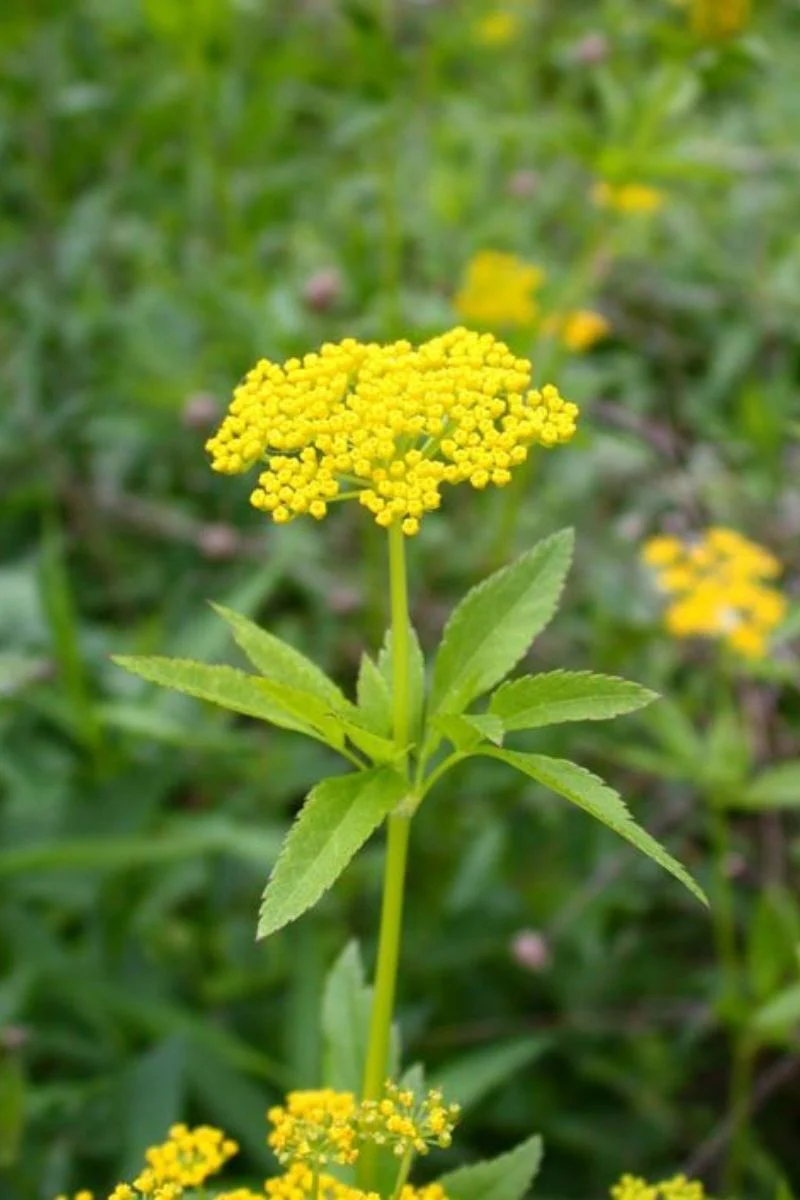
Golden Alexanders is one of spring’s most welcome native perennials—a cheerful burst of flat-topped, bright yellow flower clusters that lights up partial shade at a time when the garden is still waking up. Native to the woodland edges and moist meadows of the eastern United States, it grows reliably in part sun with average moisture, forming neat, upright clumps reaching about two feet tall. It serves as a host plant for the Black Swallowtail butterfly and draws a parade of early-emerging pollinators just when they need the foraging most. In fall, the foliage turns warm golden-yellow before winter, extending its season of interest well past the initial spring display. Deer and rabbits tend to pass it by, and it handles the challenging soil conditions near black walnut trees without complaint. Tuck it into a woodland edge, naturalized border, or rain garden where its early, bright color can be fully appreciated.
Golden Alexanders is one of spring’s most welcome native perennials—a cheerful burst of flat-topped, bright yellow flower clusters that lights up partial shade at a time when the garden is still waking up. Native to the woodland edges and moist meadows of the eastern United States, it grows reliably in part sun with average moisture, forming neat, upright clumps reaching about two feet tall. It serves as a host plant for the Black Swallowtail butterfly and draws a parade of early-emerging pollinators just when they need the foraging most. In fall, the foliage turns warm golden-yellow before winter, extending its season of interest well past the initial spring display. Deer and rabbits tend to pass it by, and it handles the challenging soil conditions near black walnut trees without complaint. Tuck it into a woodland edge, naturalized border, or rain garden where its early, bright color can be fully appreciated.
Original: $16.99
-65%$16.99
$5.95Description
Golden Alexanders is one of spring’s most welcome native perennials—a cheerful burst of flat-topped, bright yellow flower clusters that lights up partial shade at a time when the garden is still waking up. Native to the woodland edges and moist meadows of the eastern United States, it grows reliably in part sun with average moisture, forming neat, upright clumps reaching about two feet tall. It serves as a host plant for the Black Swallowtail butterfly and draws a parade of early-emerging pollinators just when they need the foraging most. In fall, the foliage turns warm golden-yellow before winter, extending its season of interest well past the initial spring display. Deer and rabbits tend to pass it by, and it handles the challenging soil conditions near black walnut trees without complaint. Tuck it into a woodland edge, naturalized border, or rain garden where its early, bright color can be fully appreciated.