Lungwort, Dark Vader
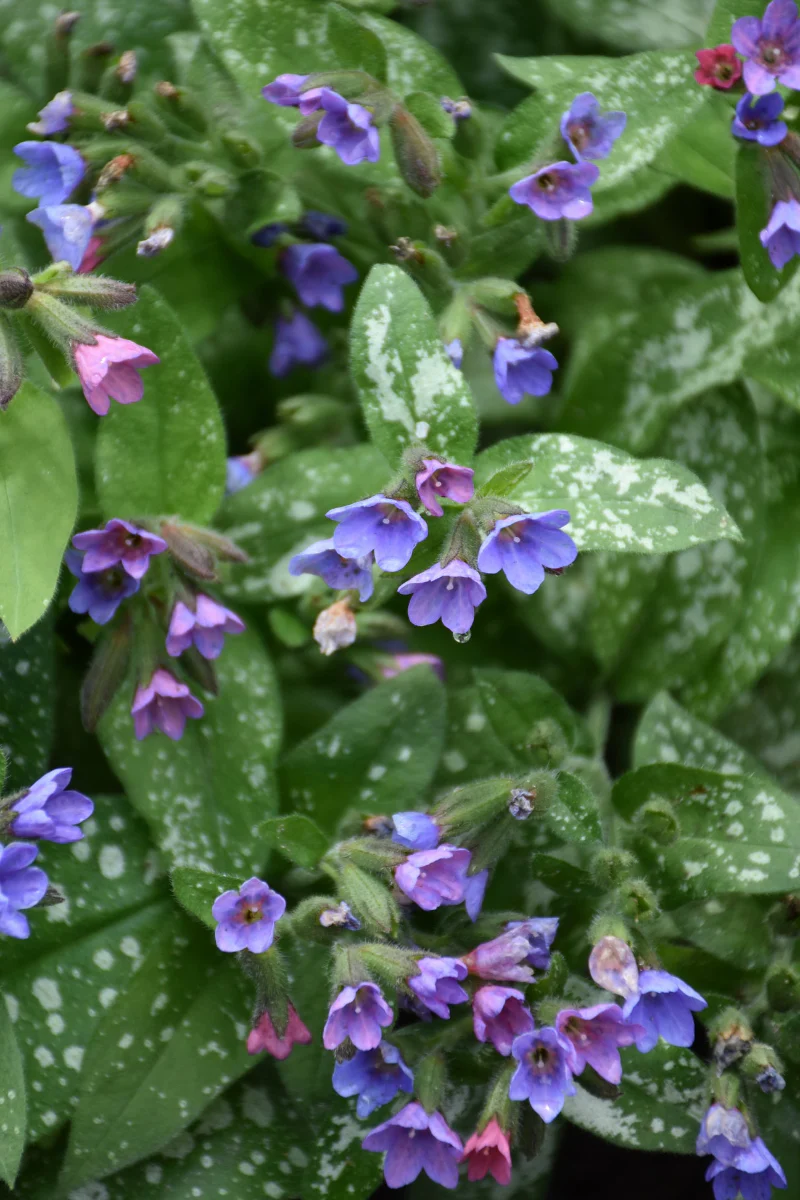
Dark Vader Lungwort brings unexpected drama to shaded and woodland gardens with its deep, near-black foliage that makes a striking backdrop for vivid purple spring blooms. The rich, intensely colored leaves have a semi-evergreen quality, providing year-round interest even after the flowers have faded. Like all Pulmonaria, it thrives in partial to full shade with consistent moisture, naturalizing beautifully as a ground cover beneath trees and along shaded borders. Deer and rabbit resistant, it’s a low-maintenance choice that asks for little beyond a woodland-style planting. Butterflies and hummingbirds are drawn to its early-season flowers, which appear when few other pollinators have much to visit.
Dark Vader Lungwort brings unexpected drama to shaded and woodland gardens with its deep, near-black foliage that makes a striking backdrop for vivid purple spring blooms. The rich, intensely colored leaves have a semi-evergreen quality, providing year-round interest even after the flowers have faded. Like all Pulmonaria, it thrives in partial to full shade with consistent moisture, naturalizing beautifully as a ground cover beneath trees and along shaded borders. Deer and rabbit resistant, it’s a low-maintenance choice that asks for little beyond a woodland-style planting. Butterflies and hummingbirds are drawn to its early-season flowers, which appear when few other pollinators have much to visit.
Original: $22.99
-65%$22.99
$8.05Description
Dark Vader Lungwort brings unexpected drama to shaded and woodland gardens with its deep, near-black foliage that makes a striking backdrop for vivid purple spring blooms. The rich, intensely colored leaves have a semi-evergreen quality, providing year-round interest even after the flowers have faded. Like all Pulmonaria, it thrives in partial to full shade with consistent moisture, naturalizing beautifully as a ground cover beneath trees and along shaded borders. Deer and rabbit resistant, it’s a low-maintenance choice that asks for little beyond a woodland-style planting. Butterflies and hummingbirds are drawn to its early-season flowers, which appear when few other pollinators have much to visit.